 LIVE DEMO
Ask Onchain
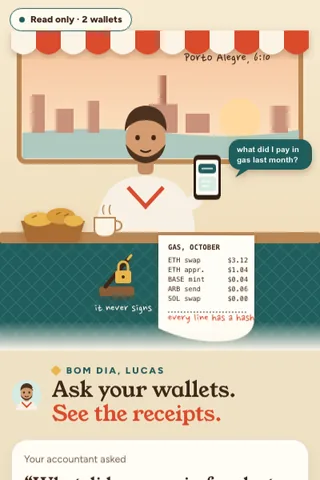
Ask your wallets plain questions, like what you paid in gas last month or when your tokens unlock. Read only, it never signs.
Yours in 1 to 2 days
$100Base · Ethereum +2
 Try it live
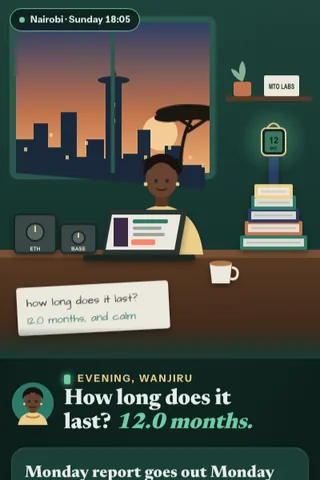
Watches a team's wallets and multisigs, shows runway in months, flags odd outflows and posts a weekly report to the team chat.
Try it live, freeYour USDC is locked in a smart contract, not sent to us. The contract lets us collect it only if we deliver within 14 days of your payment (by 15 Nov 2026 if you pay today). After that date, if we have not collected it, you take it back yourself from My apps, no permission needed. Before it, only we can refund: if we miss the promised date, ask in My apps and we refund you from the contract. View the contract on BaseScan. This covers every payment, a reservation too: the funds are released to us only when we deliver.
Promised delivery: 4 Nov 2026 (counted from payment). Self-refund opens: 15 Nov 2026 (the contract deadline).
Add-ons are not part of this payment. Once your app is delivered you can request them from My apps, and you only pay if you say yes to the quote.
Wanjiru Kamau keeps the books for a nine person open source collective in Nairobi whose money sits in two Safe multisigs and a hot wallet across Ethereum, Base and Optimism. Every month someone asks how long the money lasts, and nobody noticed that one signer had not signed in four months. Treasury Watch reads the wallets, shows runway in months at the current burn, flags outflows that do not match the team's own patterns, lists signers gone quiet for 60 days and posts a plain weekly report to the team's Slack. It never signs anything.
The team app: read only import of Safe multisigs and wallets on Ethereum, Base, Arbitrum and Optimism, runway in months at the current burn, odd outflow flags against the team's own patterns, signer activity with a 60 day quiet list, and a weekly report posted to the team's Telegram or Slack.
Reshape it entirely: new features, your flows, your brand end to end, integrations you need. We scope it with you.
Most pieces exist: KeeperHub sends DAO alerts to Telegram and Slack, Auditware's Multisig Monitor tracks signers and config drift, and treasury skills compute runway and signer inactivity. What Treasury Watch adds is the package for small teams: runway in months from spendable stablecoins only, odd outflow flags measured against the team's own spending history instead of fixed thresholds, and one plain weekly report in the team chat, strictly read only.
KeeperHub DAO alerts; Auditware Multisig Monitor; ClawHub multi sig treasury skill; Safe transaction webhooks.
Checked with web searches in October 2026. A search is not proof that nothing similar exists, and the market moves fast, so we recheck before every build.
2 live races fit this app. Each one says why, with its prize and countdown. The rule on existing code is on the race page.
A complete read only treasury monitor you own: teams see runway in months, odd outflow flags against their own patterns, quiet signers and a weekly report in their chat, and your console runs pricing, limits, growth and the watcher agent.
Every buyer gets the same finished app. Basic branding and copy changes come through a quick form.
Your admin side: revenue, paywall editor, users, rules and the agent log.
Referral and growth mechanics, switched on when you are ready to grow.
Free for up to three wallets, a monthly plan for teams that want pattern flags, signer activity and Slack across four chains, and a larger plan for organisations with several teams. The watcher is read only, so there is nothing to take a cut of.
Prices are yours to set. Illustrative, not a promise of income.
Unlocked when your app is paid in full
Unlocked when your app is paid in full
Your brand, extra chains, accounting exports, budget categories, grant report formats or a white label for a programme are scoped and priced together.
The recipe (how it is built, the data, costs, risks, build order, the pitch and the demo script) is unlocked when your app is paid in full.
Small teams and DAOs keep their money in a few Safes and hot wallets across several chains. Nobody can say in one sentence how long the money lasts, odd outflows get noticed days late, and a signer who has quietly stopped signing is only discovered when a payment cannot reach its threshold.
Most pieces exist. KeeperHub sends DAO and transaction alerts to Telegram, Slack and Discord, Auditware's open source Multisig Monitor tracks signers and configuration drift, Safe offers transaction webhooks, and published treasury skills compute runway and signer inactivity. Treasury Watch is a packaged take for small teams: runway in months from spendable stablecoins only, odd outflow flags measured against the team's own history instead of fixed thresholds, a 60 day quiet signer list, and one plain weekly report in the team chat. Strictly read only. Research verdict: exists in parts, low novelty.
Unlocked when your app is paid in full
Give every small team one honest number for how long its money lasts, and an early word when something does not look like them.
Runway in months One number at the top of every report, counted from spendable stablecoins at the current burn.
Not like us Flags compare each outflow with the team's own history: new address, odd hour, unusual size, unusual wallet.
Quiet signers Who has not signed in 60 days, and what that does to each Safe's threshold.
Unlocked when your app is paid in full
Cost per use: unlocked when your app is paid in full.
The weekly report is read by the whole team, and a footer link brings the next team. Treasurers share a runway card when they raise or renew grants, because funders ask for exactly that number.
Unlocked when your app is paid in full
Unlocked when your app is paid in full
Costs and tools are estimates at the time of writing. General information only, not legal or financial advice.
Nine routes from one vessel. Tap a port to open its chart.
Every small onchain team has the same three blind spots: nobody can say how long the money lasts, odd outflows get noticed days late, and a signer who drifted away is discovered only when a payment gets stuck. Owning Treasury Watch means you sell calm: one runway number, an early word when something does not look like the team, and a plain weekly report in the chat they already read. It never signs anything, so teams can say yes quickly.
It never asks for keys or signatures. It reads public addresses the team adds, like a block explorer that writes them a weekly letter. Lead with that sentence and most of the fear goes.
Parts do, and the app says so. Big monitoring suites are built and priced for funds. A nine person team wants one number, a few honest flags and a short Monday message. That gap is your business.
Flags are early words, not guarantees. Be clear that Treasury Watch cannot stop a transaction, only report it, and that signers act in their own wallets. Teams mark expected payments so the flags get quieter and sharper.
You do not need to. Runway is spendable stablecoins divided by the average monthly burn, shown plainly. Accountants are a partner channel, not a requirement.
A free tier for one wallet, a $29 monthly plan for real teams with several Safes, and a $99 plan for organisations and accountants with several teams. Illustrations, not promises.
Illustrative stages, not a forecast. Results depend on you and the market; nothing here is guaranteed.
LIVE DEMOAsk your wallets plain questions, like what you paid in gas last month or when your tokens unlock. Read only, it never signs.
 LIVE DEMO
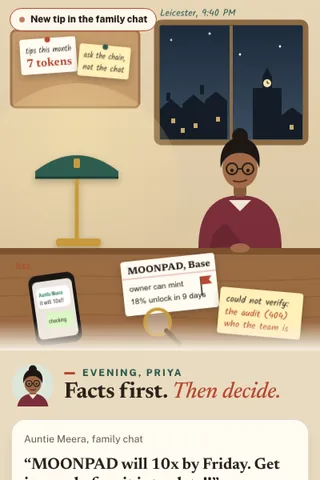
A research agent that writes a cited brief on any token or protocol, and lists what it could not verify.
 LIVE DEMO
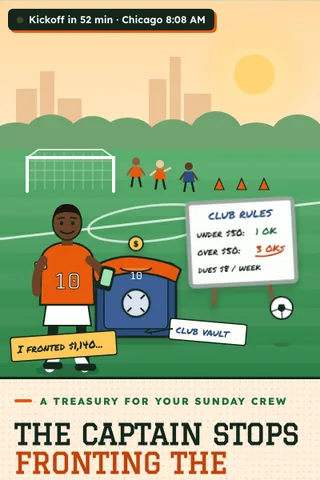
A DCA bot that buys on your schedule, skips any buy where slippage tops your ceiling, and keeps an honest buy diary.
 LIVE DEMO
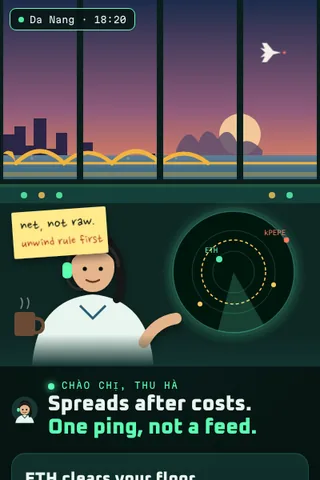
Watches funding rates across perp DEXes, pings you when a spread is worth a look after fees, and opens a hedged pair only inside your caps.
 LIVE DEMO
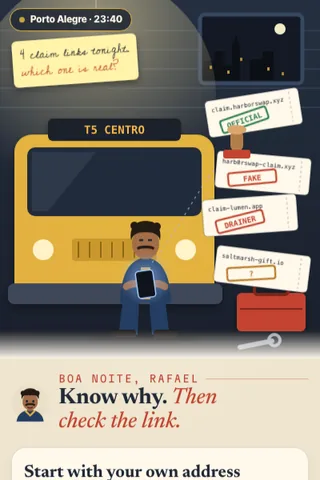
A giveaway bot that rewards verifiable onchain actions, not likes, checks one person per entry, and draws winners with public randomness.
 LIVE DEMO
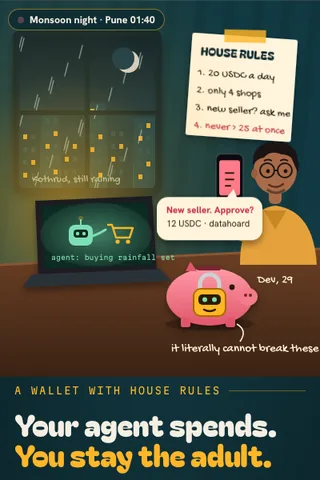
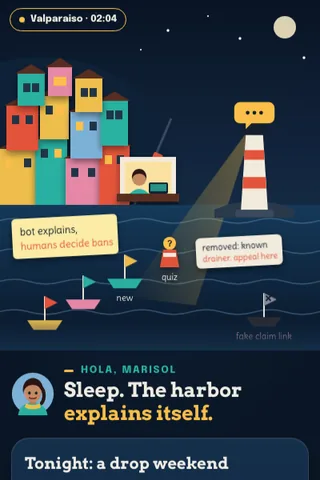
A Telegram and Discord bot for your community: onboarding quiz, token gated roles, calm moderation and onchain alerts, inside each platform's rules.
 LIVE DEMO
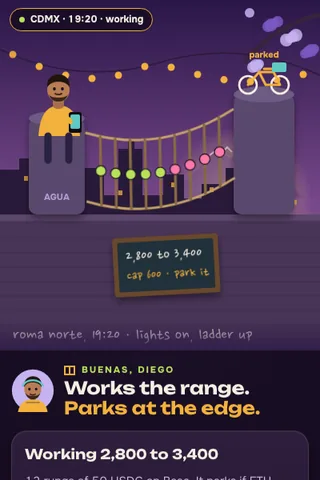
A grid bot that ladders buys and sells inside your range, then parks itself the moment price breaks out instead of bleeding.
 LIVE DEMO
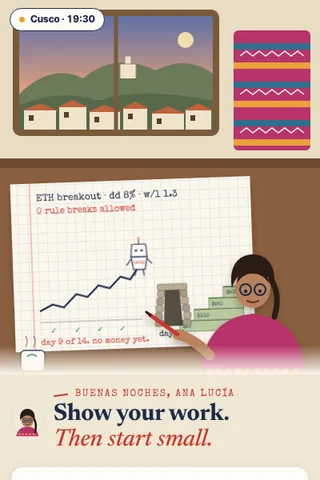
A perp strategy bot that must beat your bar on paper for 14 days before it touches real money, then starts small and demotes itself back to paper on a breach.