




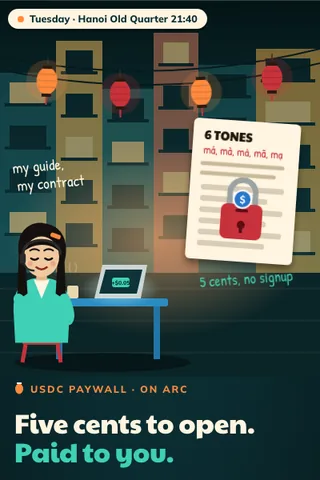
 LIVE DEMO
USDC Paywall
Lock content behind a fraction-of-a-cent USDC payment, on your own Arc contract. Deploy it, become the onchain creator.
Ready now
$100Arc
 Try it live
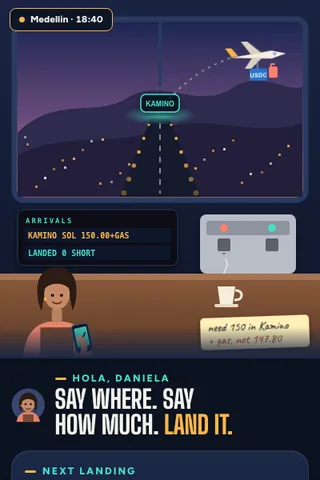
Your own bridge aggregator that works backwards from arrival: pick the app you are going to, and it lands the exact amount plus gas there.
Try it live, freeYour USDC is locked in a smart contract, not sent to us. The contract lets us collect it only if we deliver within 14 days of your payment (by 15 Nov 2026 if you pay today). After that date, if we have not collected it, you take it back yourself from My apps, no permission needed. Before it, only we can refund: if we miss the promised date, ask in My apps and we refund you from the contract. View the contract on BaseScan. This covers every payment, a reservation too: the funds are released to us only when we deliver.
Promised delivery: 4 Nov 2026 (counted from payment). Self-refund opens: 15 Nov 2026 (the contract deadline).
Add-ons are not part of this payment. Once your app is delivered you can request them from My apps, and you only pay if you say yes to the quote.
Daniela Ruiz, a barista in Medellin, saves in USDC on Base and kept arriving on Solana a few dollars short of the 150 she needed for a lending vault, with no SOL left to use it. With Landing Gear she picks the app and the amount that must land, sees every fee added on top before she signs, and gets 150 USDC plus a little gas waiting on arrival. When a bridge stalls, the stuck transfer helper shows her exactly where the money is and how to get it back.
The user app: destination app picker, amount that must land, gas on arrival, LI.FI routing across Base, Arbitrum, Optimism and Solana with a worked backwards quote, short landing stop and re-quote, stuck transfer helper with refund path, arrival receipts, plans and checkout, and your disclosed routing fee wired to your wallet.
Reshape it entirely: new features, your flows, your brand end to end, integrations you need. We scope it with you.
Aggregators already quote by output amount and add destination gas (LI.FI contract calls with toAmount, LI.Fuel), and pay-anywhere tools like Daimo Pay land exact amounts for merchants. What we did not find as a consumer front end is the combination: an app picker as the starting point, a quote that works backwards and stops if a fresh quote would land short, arrival receipts, and a stuck transfer helper with the bridge's own refund path, run by an owner who discloses their routing fee.
Jumper and the LI.FI widget (route by chains, not destination apps), LI.FI contract calls and LI.Fuel (the building blocks), Daimo Pay (exact amount arrival for merchants), and in this catalog jumper-dex (community swap page) and guardrail-router (personal bridge policies).
Checked with web searches in October 2026. A search is not proof that nothing similar exists, and the market moves fast, so we recheck before every build.
3 live races fit this app. Each one says why, with its prize and countdown. The rule on existing code is on the race page.
A destination first bridge app you own: people pick the app they are going to and the amount that must land, it routes through LI.FI with gas on arrival, and you earn a disclosed routing fee on every landing plus optional plans.
Every buyer gets the same finished app. Basic branding and copy changes come through a quick form.
Your admin side: revenue, paywall editor, users, rules and the agent log.
Referral and growth mechanics, switched on when you are ready to grow.
A routing fee on every landing, set as the LI.FI integrator fee and paid to your wallet, plus optional monthly plans for people and teams who land often. The fee is printed on every quote and receipt.
Routing fee of 0 to 0.5 percent of each landing (default 0.25 percent), collected by LI.FI as your integrator fee and shown to the user before they sign. Refunded transfers carry no routing fee.
Prices are yours to set. Illustrative, not a promise of income.
Unlocked when your app is paid in full
Unlocked when your app is paid in full
Your brand and domain, your list of destination apps, more chains, deposit on arrival for specific apps, community fee splits and alert channels are scoped and priced together.
The recipe (how it is built, the data, costs, risks, build order, the pitch and the demo script) is unlocked when your app is paid in full.
People move money between chains to use one specific app, but bridges ask which chain and which bridge, not where you are going. They arrive a few dollars short of what the app needs, with no gas to act, and when a transfer stalls they have no idea where the money is.
Most of the parts exist. LI.FI, Socket and others aggregate bridges, LI.FI can quote by the amount that must arrive and add destination gas, and tools like Daimo Pay land exact amounts for merchants. Landing Gear is a front end that starts from the destination app and the amount it needs, works the quote backwards, refuses to land short without asking, adds gas by default, writes an arrival receipt and walks people through a stuck transfer. Research verdict: the routing is not new, the destination first flow and the short landing promise are uncommon. Medium novelty.
Unlocked when your app is paid in full
Moving money to an app should feel like booking a flight: say where you are going, see the full fare, and land with what you need.
Nothing short If a fresh quote would land even a cent below what you asked for, it stops and asks before anything is sent.
Gas on arrival A little SOL or ETH lands with the money by default, so the first tap on the other side works.
The arrival receipt Needed, sent and landed with both hashes, ready to share or export.
Unlocked when your app is paid in full
Cost per use: unlocked when your app is paid in full.
Arrival receipts are the ad: 'landed 150, nothing short' with the route and fees. Communities pin a Land here link that opens with their app preselected, and the stuck transfer helper is found by people searching for help after a stall elsewhere.
Unlocked when your app is paid in full
Unlocked when your app is paid in full
Costs and tools are estimates at the time of writing. General information only, not legal or financial advice.
Nine routes from one vessel. Tap a port to open its chart.
Every day, people in crypto communities ask the same question: how do I get my money to that app on that chain? Owning Landing Gear means you answer it with your own app: they pick the app and the amount, it lands exactly that plus gas, and you earn a routing fee you show on every quote. You can start with one community you already help and grow into the page every new user is sent to.
You are not running a bridge. LI.FI finds the route and the bridges move the money; your app picks the destination, shows the full fare and watches the transfer. Your job is choosing which apps and bridges to list, and the console makes that a set of toggles.
That risk is real and the app says so plainly. You only allow bridges you have reviewed, you can switch one off in seconds, and you never hold user funds. Tell users clearly that bridging can lose money and never call it safe or insured.
Hidden fees are the scam. Yours is printed on every quote and receipt, it is in the normal range for aggregator front ends, and Frequent users pay half. Say what it pays for: the app, the watcher and the helper when things stall.
They route by chain. Yours starts from the app someone is trying to reach, adds gas, refuses to land short and helps when transfers stall. Your edge is also distribution: the community that already trusts you.
A disclosed routing fee on landing volume plus Frequent and Crew plans, growing through Land here links that communities pin for their newcomers.
Illustrative stages, not a forecast. Results depend on you and the market; nothing here is guaranteed.
LIVE DEMOLock content behind a fraction-of-a-cent USDC payment, on your own Arc contract. Deploy it, become the onchain creator.
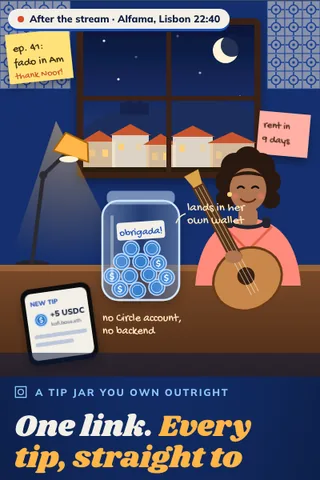 LIVE DEMO
Take pay-what-you-want USDC tips on Base, with a live supporters feed read straight from chain. No Circle account, no backend.
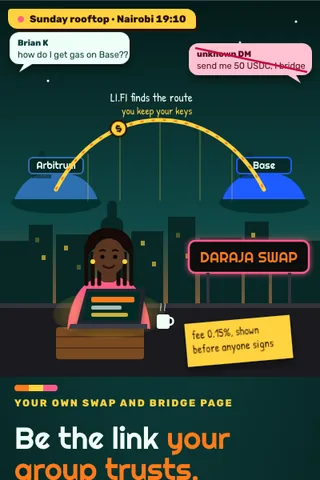 LIVE DEMO
Your own swap/bridge front-end. Integrator fee optional and disclosed.
 LIVE DEMO
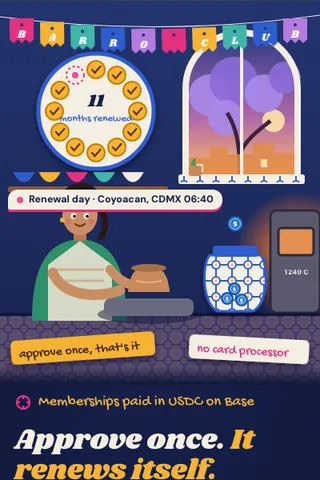
Recurring USDC on Base. Members approve once, it renews itself. No card processor, no contract.
 LIVE DEMO
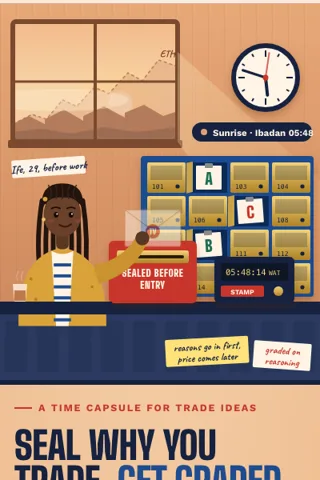
Write why you entered a trade, seal it with the timestamp, and get graded on reasoning, not luck.
 LIVE DEMO
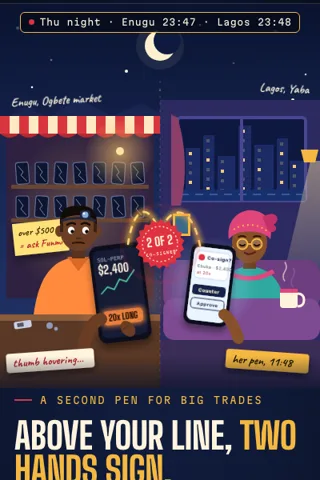
Let a trusted mentor co sign your risky trades above a size you choose.
 LIVE DEMO
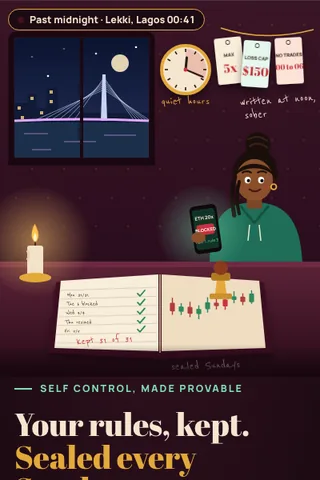
Your perp bot follows your rules, and every rule you kept becomes a public, provable track record.
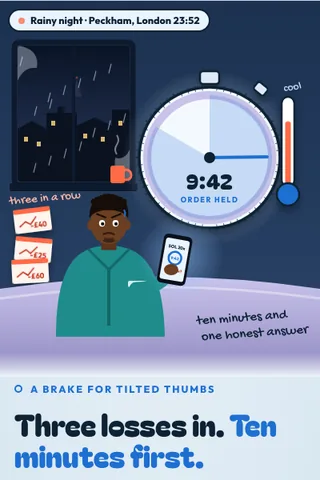 LIVE DEMO
A tilt brake that delays your trades after losses until you answer one honest question.